
Published: March 3, 2026 | Reading Time: 8 minutes | Author: Pablo & Cristina, NomaTrails Founders
Here at NomaTrails, we don’t think of running as a way to get fit or improve our race times. For us, it’s much more fundamental. We use our legs, our lungs, our hearts, just as a means of transportation. It’s a way to explore, to traverse a territory like our ancestors did. While we spend our seasons guiding our tribe through the rugged Pyrenees and the coastal trails of Costa Brava, we know that for many of our UK friends, that spirit begins closer to home. And that’s why this guide to **running Helvellyn** is so important to us. It’s not just England’s third-highest peak—it’s a place where you can find the kind of adventure that changes you, a story you can tell your grandkids.
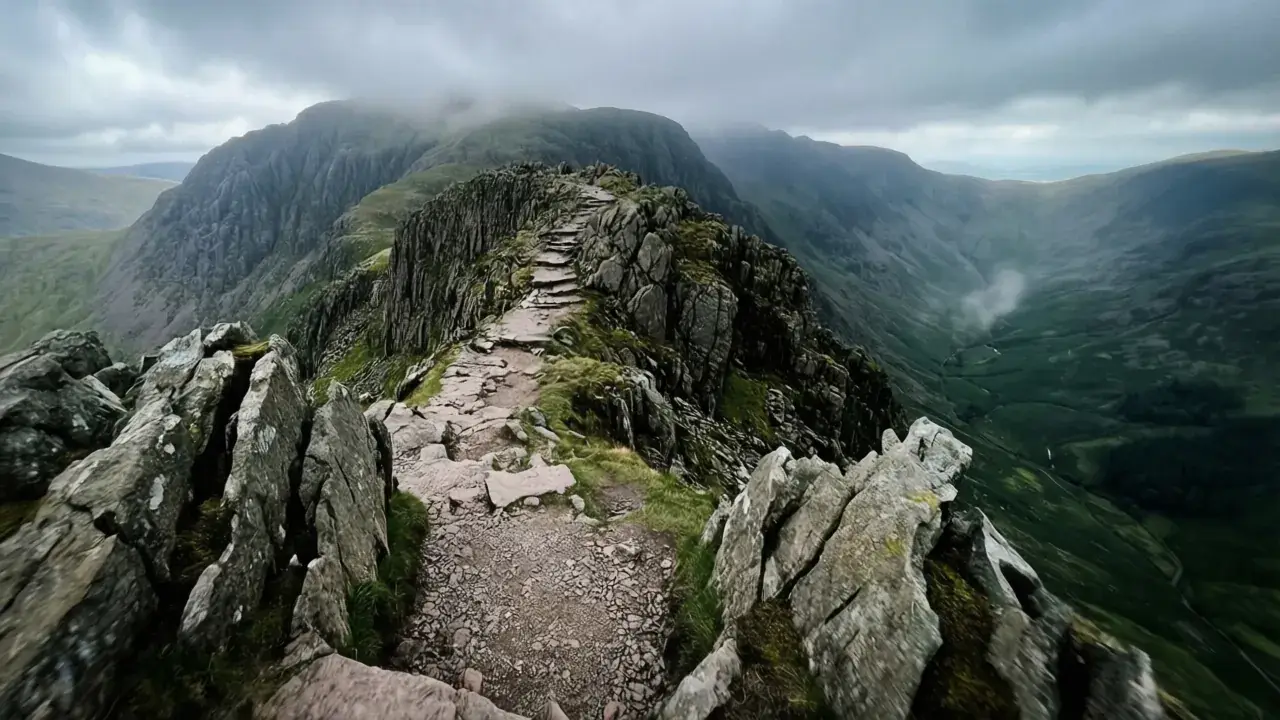
Helvellyn stands at 950 meters (3,117 feet), but its power isn’t just in its height. It’s in the character of the mountain. I remember seeing Striding Edge for the first time. It’s this narrow, rocky ridge that just slices through the sky. It reminds me of some of the high passes we cross in the Atlas Mountains in Morocco—places that demand your full attention.
This is what we mean when we say we use running to connect with a place. You can’t just blast across Striding Edge looking at your watch. You have to feel the rock beneath your shoes, place your hands, and breathe with the mountain. It becomes a conversation. This is the heart of the NomaTrails philosophy: it’s not about the clock, it’s about the experience. It’s about moving through a place in a way that only runners can, and letting it leave a mark on you.
Distance: 14km | Elevation Gain: 900m | Estimated Time: 3-4 hours
This is the one. The full Helvellyn story. You start from Glenridding, climb up towards Red Tarn, and then you face the Edge. It’s technical, it requires some scrambling, and you need a good head for heights. But the feeling… it’s incredible. The views are just unparalleled.
My advice? Don’t rush it. Give yourself permission to stop. Breathe in that mountain air. This isn’t a race. It’s an exploration. The descent via Swirral Edge completes a perfect, tough loop that will stay with you long after you’re back in the pub.
Distance: 10km | Elevation Gain: 750m | Estimated Time: 2.5-3 hours
If you want the summit views without the knife-edge exposure of Striding Edge, this is a beautiful way to do it. It’s a more gradual, steady climb from the west. It’s the perfect route for building your confidence in the mountains. We see it all the time on our trips—people start on terrain like this and a few years later they’re crossing high passes in the Pyrenees with us. This is how you build that foundation.
Distance: 8km | Elevation Gain: 600m | Estimated Time: 2 hours
Okay, this is for those of you who are truly one of us. It reminds me of an experience we create in Morocco. Our guide there, Abdu, will wake our group at 3 in the morning to run through the desert in the dark. It sounds crazy, but then you stop, look up at the stars, and watch the sunrise over the dunes. It’s a moment of pure magic.
You can find that same magic on Helvellyn. An early start from Thirlmere, running by headtorch, to reach the summit as the sun comes up. The world is quiet, the valleys are filled with mist, and the Lake District turns gold. Trust me, it’s an experience you will never, ever forget.
A wild mountain demands respect. I’ve learned this over 12 years of guiding, whether in my backyard in Girona or deep in Costa Rica. The weather can turn in an instant. Preparation isn’t just a good idea; it’s your responsibility to yourself and to the mountain. Here’s what you need:
Spring (April-May): Beautiful, but be careful. Snow can linger on the tops, especially in the gullies. Packing a pair of microspikes is a smart move.
Summer (June-August): The conditions are best, but you’ll be sharing the trail. We always say the best adventures happen when you have the place to yourself. Go very early or on a weekday.
Autumn (September-October): My favourite time. The colours are incredible, the air is crisp. Just watch the daylight—the days get short quickly.
Winter (November-March): This is a different beast entirely. Running Helvellyn in winter is serious mountaineering. You need an ice axe, crampons, and the knowledge to use them. For experienced winter runners only.
If you see this as an adventure, not a race, the preparation becomes part of the joy. Your body needs to be ready for the steep climbs and descents.
On our trips, safety is everything. It’s the foundation that allows for real adventure. Helvellyn is no different. It’s a serious mountain.
Base Camp: Glenridding or Patterdale are perfect. You can find everything from a simple campsite to a cozy hotel. Waking up with a view of the fells is the best way to start the day.
Transport: Parking can be tough, especially in summer. Get there early. It’s part of the pre-dawn magic we talked about.
Post-Run Recovery: This is a critical part of the experience! Just like we have big celebration dinners with local wine in Catalonia, find a good pub in Glenridding. A pint of local ale and a hot meal with your friends, sharing stories from the trail… that’s what it’s all about.
So, you’ve done it. You stood on top of Helvellyn, you felt that wind on your face, and you thought, “This is it. This is what I want to do.” If that fire is lit, if the idea of traversing a landscape point-to-point for days on end sounds like a good idea, then you’re one of us. And we have some places to show you.
But be careful. These trips we do… they change you. They will transform you.
Why Progress to the Pyrenees?
Ready to Level Up? Download our free Pyrenees Mountain Running Brochure to see what we mean:
Download Your Free Pyrenees Running Brochure →
These aren’t just trips on a map. These are places where we have deep relationships, where our guides are like family.
About the Author: I’m Pablo, and with my wife Cristina, we started NomaTrails. We are a family of guides and runners who believe that using our bodies to traverse a landscape is the most human thing we can do. We’ve run thousands of kilometers, but what we remember are the people we’ve met and the stories we’ve shared.