
From the Pyrennes to the Mediterranean Sea
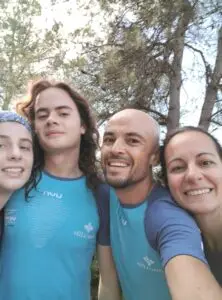
Hey, I’m Pablo, NomaTrails’ lead runner.
We run the Pyrenees, it’s simple, really. The south of France, we call it home, you see, because it’s still Catalonia, part of our land, and for seven years, I kept thinking we could hold an event, one of our run tours, right across those mountains.
It felt right.
Girona folks, we always look North.
We only head to Barcelona if we absolutely have to, honestly, the Pyrenees is where we spend most of our time, since Girona’s province holds the highest peaks in our part, and Northern Catalonia, what we call the south of France, feels even more like home than south of Barcelona.
It’s just different.
Families here, they hit the mountains.
On weekends, it’s normal for everyone to go walking, exploring the vast, beautiful places we’ve got, so we basically never repeat a route, which means we’ve ended up discovering the entire Pyrenees, at least all of it around Girona, and a big chunk of the French side too.
That’s how we roll.
Figuring out where to run, that was tough.
When I first wanted to organize this big event, we hadn’t nailed down an exact route, and while there are classic trails like the GR11 or the GR10, those didn’t quite capture the spirit I was after.
We needed more.
Catalonia adopted me, that’s my story.
I came from Costa Rica, and I’m telling you, this is the only place I know where a foreigner truly becomes a local, you just want to be Catalan, speak the language, and you’re in, so I’ve always been ‘more Catholic than the Pope,’ obsessed with Catalan culture, its classic authors, literature, and poets – I was, actually, thinking back, a pretty strange kid.
It was a passion.
One day, on the radio, I heard someone talking about Jacint Verdaguer and his epic poem, *The Epic of Canigó*.
That poem just grabbed me, I dedicated so much time to reading it, almost memorizing it, because I saw it as a geographical tool, incredibly precise, almost proof of time travel; how could anyone, without satellite images, GPS, or even aerial photos, know these valleys, towns, rivers, and mountains so intimately?
Verdaguer connected everything.
The poem builds on the idea of a journey.
The Queen of the Fairies takes the protagonist to tour the Pyrenees in a flying carriage pulled by deer, and that’s when I decided: I’d follow that carriage, I’d run Verdaguer’s route.
My exploration began.
That exploration took time, happy time.
I spent it doing what I liked best: running through the mountains, following the valleys, rivers, and paths that Verdaguer describes in his poem, feeling like Dante, but with Verdaguer as my guide, showing me every turn.
It was incredible.
The poet describes so many moments.
Our beautiful Pyrenees-to-Med route has countless spots depicted with absolute precision, like the Epilogue he wrote, speaking of the “Superb abbeys, what has come of you all? Marcevol, Serrabona, Sant Miquel, And crumbling San Marti, who with your strains Of psalms and melody once filled the vale.”
He saw it all.
We had the route, the idea.
We were following what and where, connecting valleys behind a single idea: Canigó, crossing the Tet, Tec, and Ter valleys, all born from the Canigó mountains, from the Pyrenees chain, giving our route meaning, a reason, even a political idea for the ancient Catalan nation.
It’s deep stuff.
Canigó also symbolizes something profound.
It’s a sacred mountain for Catalans from both France and Spain, representing an ancient myth of light, where on the summer solstice, the light of Canigó generates a flame, like the Olympics, carried with mirrors throughout Catalonia, leading to a massive celebration in all Catalan places, from Valencia to an Italian city.
It’s pure magic.
Joan Manuel Serrat sings of San Juan.
He says, “On the night of San Juan, everyone shares their bread, their wife, and their homes,” meaning they share their house, their food, and their partner; it’s a night of absolute madness, a night when if someone wants to do something wrong, then this is the night they have to do it.
Total freedom.
Canigó connects the entire country.
When I say ‘country,’ I mean all of Catalonia; we clearly see Canigó from Girona, and from the Mediterranean Sea, you can spot its snowy peak, so for many years, we used to think Canigó was the highest mountain in the entire Pyrenees, because from the stop on its north side, where we slept one night, it looks like a giant, rising alone.
It’s deceptive.
Summitting in two days feels impossible.
But we do it – generally, if there’s no snow, we beautifully ascend, following the poem’s verses, our path twisting through the ancient limestone, feeling every step of Verdaguer’s vision.
We make it happen.
We go North to South.
Our aim is to traverse mountains and hit the Mediterranean, with Canigó always our reference point, passing through three beautiful valleys, each reflecting a different verse, with some sitting in Northern Catalonia, French territory, and others in Southern Catalonia, Spanish territory, but each a small country in itself.
You feel the shift.
You’ll clearly see things, like French architecture.
But the wine, the food, and obviously the language also change; in French Catalonia, they speak a lot of French, while in Spanish Catalonia, we mainly speak Catalan, and you’ll definitely see this difference on the itinerary we run with you.
It’s a real experience.
Day one, we hit the Vallespir.
We pass through the valleys near Prada, where some of the best wines are produced, and that night, we sleep in Prada in the house of a good friend who prepares a fantastic dinner for us in his backyard, a truly local, small rural accommodation.
Real Catalan hospitality.
The next day, we climb to the Cortalets or Marialles refuge.
Many factors dictate the exact route we take to either refuge; honestly, we’ve climbed differently all seven times, but the forest is absolutely beautiful, changing with elevation, path, and season, a really hard and short climb, but it’s worth it because that world at the foot of Canigó is unique.
The air is different.
You’ve got to experience the mountain refuge atmosphere.
It’s not a hotel; it’s a place where we all sleep together, almost like children, but the mountain atmosphere is extraordinary, and you can’t drive there, no motorized means will get you to these remote havens.
It’s pure mountain.
We get up early, try to climb Canigó.
When I say ‘try,’ I mean we’re not sure we can do it; it depends on so much: snow, too much wind, or a sudden Tramuntana whipping through the peaks, but we always approach the mountain cautiously, accepting what the day throws at us.
Safety first, always.
We always look for a way to continue south.
We cross the Pyrenees chain, going up to a beautiful place called Plaguillan, also described in the poem, and then descend towards the Tek River valley, where a wonderful place waits for us in the town of Prats de Mollo.
The landscape shifts.
The next day, we cross the border.
We start climbing again, and we’ve got a relatively short day to the dump, which is, honestly, extremely horrible, but then we descend through some beautiful green meadows with a gentle slope, letting us run fast until we hit Camprodon, another town right out of Verdaguer’s verses.
What a contrast.
We’re getting closer to the Mediterranean.
This fourth day, the paths open up even more, we’re still going south, but we see so many beautiful places, sometimes hitting Santa Pau, other times Beget, until we finish in Castellfollit de la Roca, ending the day with a short car ride back to Girona.
Back to base.
This last day, we hit the Mediterranean area.
From Girona, we started moving towards Ampordanet, running through the most beautiful medieval villages you have ever seen, each one a postcard, steeped in history, smelling of ancient stone and wild rosemary.
Pure magic.
Finally, we reach the extraordinary, beautiful sea.
Those who see us arrive don’t know where we come from; the story of our route up to this moment would make their mouths drop, a route a local could only dream of, because it’s very complicated to pull off, connecting everything.
It’s truly unique.
Many Girona folks know some of these places.
They’ve driven for hours to reach a valley, perhaps visited another spot we pass through on a different year, but they’ve never connected them all; they really don’t know the paths that link them, or maybe they’ve just heard whispers of them.
We show them how.
Girona, it’s true, holds immense mountain tradition.
The best runner in the world, Kilian Jornet, is from the province of Girona, a testament to our rugged terrain and the spirit of our people, but even he’d be impressed by this connected route.
It’s our heritage.
This’ll be our first contact with the sea.
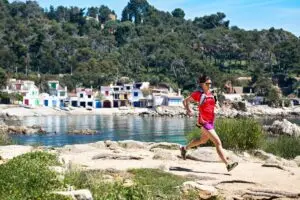
The last day? Just a celebration; we run along the coast, throwing ourselves into every beach we find, and we’ll retrace the route we made in our minds, a unique route, a dream, a dream for me, and for anyone who gets it.
What a finish.