Run Downhill Faster: Hardrock Lessons & NomaTrails Wisdom
The last time I toed the line at Hardrock 100, it hit me hard: the real secret to **run downhill faster** in ultramarathons isn’t just about climbing. That race, with its brutal average elevation over 11,000 feet and more than 32,000 feet of ascent and descent, always teaches you something profound. Every race, every trail, every step out there is a learning experience, a chance to connect with the land and with ourselves. For us at NomaTrails, running isn’t just about fitness or speed; it’s about exploration. It’s a way to truly traverse a territory and build a deep, personal relationship with the places we visit, just like our ancestors did. We don’t just ‘discover’ places; we live them, we breathe them, we become a part of them, even if for a short while.
The Hardrock Downhill Story
To really get what I’m talking about, let me tell you a story from that Hardrock race. Most of it was a grind, honestly. The climbs just went on forever, so slowly my GPS watch wouldn’t even register that I was moving. But then there was this one section, the second to last downhill from Stony Pass into the Cunningham Aid Station. Man, that was a moment.
That descent, it’s a strange mix of relief and dread. Relief because you finally see your crew after what feels like an eternity, one of the longest crew-less sections on the course. And you know, only nine miles left to go. You get a little burst of spiritual uplift.
But then, BAM. That feeling is immediately exorcised by the view of the next beast: the 2,400-foot gut punch of a climb they call Little Giant. Seriously, it’s a 13,000-foot ridge. Calling it ‘Little Giant’ is like calling the biggest guy at the bar ‘Tiny’. It’s a joke.
I started down that bone-crushing descent to the aid station, thinking I was doing pretty well, pushing a reasonable pace. I was fueled by the thought of those Michelin Star-worthy Pringle, avocado, and bacon sandwiches waiting for me at the aid station. (Seriously, why aren’t those on every fine dining menu?). Then, out of nowhere, Shinsuke Isomura from Japan just *flew* by me. I mean, like I was standing still. He passed me about half a mile before Cunningham and beat me into that aid station by nearly 10 minutes. Ten minutes! For us math geeks, that’s him skipping and bounding over rocks 20 minutes a mile faster than me. And the kicker? I thought I was running relatively well.
Aside from just lamenting my lack of athletic prowess in that moment, the experience was a stark reminder. We put so much focus on the uphill side of the ‘vert’ equation, don’t we? But the downhill side? It’s just as, if not more, important. It can make or break your race, your adventure, your whole experience out there. It’s about more than just your lungs; it’s about how you move, how you connect with the ground beneath your feet, and how much you trust yourself. It’s about learning to truly **run downhill faster** without fear.
Why Downhills Matter for Ultramarathons
For a long time, I actually believed that overall race performance was mostly about how fast you could climb. I figured if you improved your climbing by one percent, it would be worth more than a one percent improvement on the downhills. After all, you spend more time ascending than descending, right? But then I started looking at the data, listening to the science, and seeing it firsthand on our NomaTrails adventures.
I was recently reminded of some fascinating research, thanks to Marlene Giandolini from Salomon’s Sports Science laboratory and the French running magazine Zatopek. They compared the uphill and downhill speeds of the first 30 and last 30 finishers of UTMB. It was a literal ‘front of the pack to back of the pack’ comparison. What they found was that all runners, naturally, slowed down both uphill and downhill as the race went on. But here’s the kicker: the top 30 finishers slowed down remarkably *less* on the final descent compared to the last 30 finishers. It’s like they had this secret weapon for the downhills.
What does this tell us? The better runners are disproportionately resistant to downhill fatigue compared to uphill fatigue when you stack them against the slower runners. You can see this clearly in the charts. On the final climb, the top 30 and bottom 30 runners were separated by about 5% of their mean speed. But on the descent? They were separated by a whopping 18%! That’s huge. It really drives home the importance of being able to **run downhill faster** and sustain that speed, especially when you’re tired.

All of this brings us to the big question: “How do I get better on the downhills?” It’s a two-pronged answer, and one where we can lean on both practice and solid science. It’s not just about pushing hard; it’s about smart training and connecting with the trail, just like we do on our NomaTrails expeditions. It’s about building a relationship with the terrain.
Skill Determines Your Best Downhill Speed
We often think of endurance activities like running, cycling, or triathlon as purely about cardiopulmonary factors. You know, VO2 max, running economy, how much oxygen you can suck in and how efficiently your body uses it. Generally, better performance means a bigger VO2 max and a more efficient running economy. But when it comes to dominating a downhill race, we need a different set of parameters. It’s not just about raw engine power.
We know from research that it’s nearly impossible to hit your VO2 max on even the slightest downhill grades (Lemire et al 2020). And if that wasn’t enough, running economy, which is king on the roads, has very little correlation with performance in mountainous ultras (Pastor et al 2022). Then there’s that UTMB speed profile I mentioned earlier – even the best runners are still moving at a comfortable pace on descents, even the early ones where they’re flying at 126% of their mean race speed. That’s still way easier than their lactate threshold pace.
So, if your heart and lungs, and raw foot speed, aren’t the main drivers for downhill performance, what is? For us at NomaTrails, we believe it starts with skill. It’s about how you dance with the trail, how you read the terrain, how you let your body flow. It’s about having that deep relationship with the place, knowing its quirks and trusting its ground, much like knowing your own backyard. It’s about letting the trail become an extension of yourself.
Developing Downhill Running Skills to Run Downhill Faster
When we talk about developing skill, we often look at sports like golf or tennis. They refine technique through repetition, usually in low-load situations. Golfers hit the driving range, practicing different shots over and over before they ever step on the course. They hone that skill when they’re fresh.
Ultrarunners can absolutely take a page from that book. The solution, I’ve found, is simple, and it’s at the heart of what we do on our running adventures:
- **Find a technical trail.** This could be anything from the rocky paths of the Pyrenees to the root-strewn forests of Costa Rica, or the ancient tracks of the Costa Brava, where we’ve spent 12 years getting to know every rock and every local. We have a deep relationship with these trails, like they’re our own grandma’s backyard.
- **Run it repeatedly.** Don’t just do it once. Go back. Feel the nuances. Let the trail teach you its secrets.
- **Do this in a ‘low load’ situation at the beginning of your run.** When your legs are fresh, your brain is sharp. That’s when you build the neural pathways.
Then, you can gradually ratchet up the technique. Go over the trail faster in subsequent sessions, or, my preference, find an even *more* technical trail to do over and over. In either case, you’re overloading the skill gradually, either through speed or the sheer difficulty of the terrain. This is how we build that deep connection with the land that I talk about, where running becomes an exploration, not just a workout. We use our legs, our bodies, our lungs, our heart as a means of transportation, to traverse the territory like only runners can do it.
Now, if you live in a city and don’t have access to technical trails, I’ll be honest, I don’t have a magic answer for you. I’m not convinced that contrived drills in a gym – like landing drills or speed ladders – are really that useful for trail running. While I’d love to offer a workaround for city dwellers, I genuinely think your time is better spent simply running more miles, building that base, rather than trying to gain skill in an artificial environment. Real trails teach real skills to **run downhill faster**.
Fatigue Resistance: Sustaining Downhill Speed
I’ve really come to appreciate that the uphill component of trail running requires a different training strategy compared to the downhill. Uphill prowess is largely about traditional endurance indicators – the strength of your cardiopulmonary system. Those adaptations take weeks, months, hundreds of hours of training. You know this instinctively; you spend months agonizing over your longest long runs and peak mileage weeks.
But the downhill side of the performance equation? That’s a whole different beast. Instead of being dominated by your heart and lungs, downhill running seems to rely on neural, neuromuscular, and musculoskeletal adaptations. We’re talking about how well your brain sends signals to your muscles, how much that signal fades over time, and the sheer strength of that supporting framework in your legs. It’s about resilience, about your body’s ability to absorb and adapt to impact.
Why such a stark contrast? It’s fundamentally because running uphill primarily involves concentric muscle activation – the muscle shortens as it’s activated. Running downhill, however, is all about eccentric muscle activation – the muscle lengthens while it’s activating. And the great news for us trail runners is that scientists know a lot about how adaptations occur from eccentric exercise. For more on the science, check out this review on eccentric exercise from the National Institutes of Health.
Eccentric Contractions and the Repeated Bout Effect
Scientists have been studying something called the ‘Repeated Bout Effect’ for more than 40 years. The core idea is that just one bout of eccentric exercise can offer a robust, long-lasting adaptation that protects you against future bouts of that same eccentric exercise. This effect is so strong, they sometimes call it the ‘inoculation effect’ – like a single dose inoculates you from damage during future efforts. It’s a powerful, almost magical, response from your body!
Hyperbole aside, it’s genuinely hard to find another adaptation in exercise science that’s as robust, especially one stemming from a single bout of exercise. This was beautifully highlighted in recent research from the University of Calgary by Arash Khasserarash. In their study, they had recreational runners do a single 30-minute run on a treadmill at a 20% downhill slope at a 9:34 min/mile pace. Then, they brought them back into the lab three weeks later for the exact same run and compared the effects.
Between those two tests, the runners did no other running or training. So, any improvements observed were directly attributed to that single 30-minute downhill run. And despite such a simple, singular intervention, measures like muscle soreness, neural drive, and loss of maximal voluntary force production were all statistically improved from the first bout to the second. That’s powerful stuff for anyone looking to **run downhill faster** and with less pain.
NomaTrails Wisdom: Downhill Training in the Wild
Now, do you think a similar adaptation would happen if you did one 30-minute *uphill* run and then took three weeks off? Not a chance. If anything, you’d probably feel worse after three weeks off (just ask any injured runner!). This tells us something crucial: integrating specific downhill training, even in short, focused bursts, can have profound, lasting effects on your ability to **run downhill faster** and with less fatigue.
This is exactly why on our NomaTrails trips, whether we’re traversing the rugged trails of Sicily or exploring the wild Atlas Mountains of Morocco, we emphasize these dynamic, varied experiences. I remember our guide Pasquale talking about Sicily, how we’d start from the sea, pass through the rural interior, these ancient villages, then climb into the mountains. We wouldn’t just go straight up, but traverse its valleys, its “weak points,” before descending back to the sea, maybe sleeping in a village like Isnello, where you can practically see the ocean from your window. It’s not just about logging miles; it’s about engaging with the terrain in a way that builds skill and resilience, preparing your body for the unique demands of mountain running. And sometimes, you’re even “forced” to take transport for a short, quick transfer because the coast literally becomes a mountain dropping into the sea – it’s all part of the local experience, part of understanding the rhythm of the land.
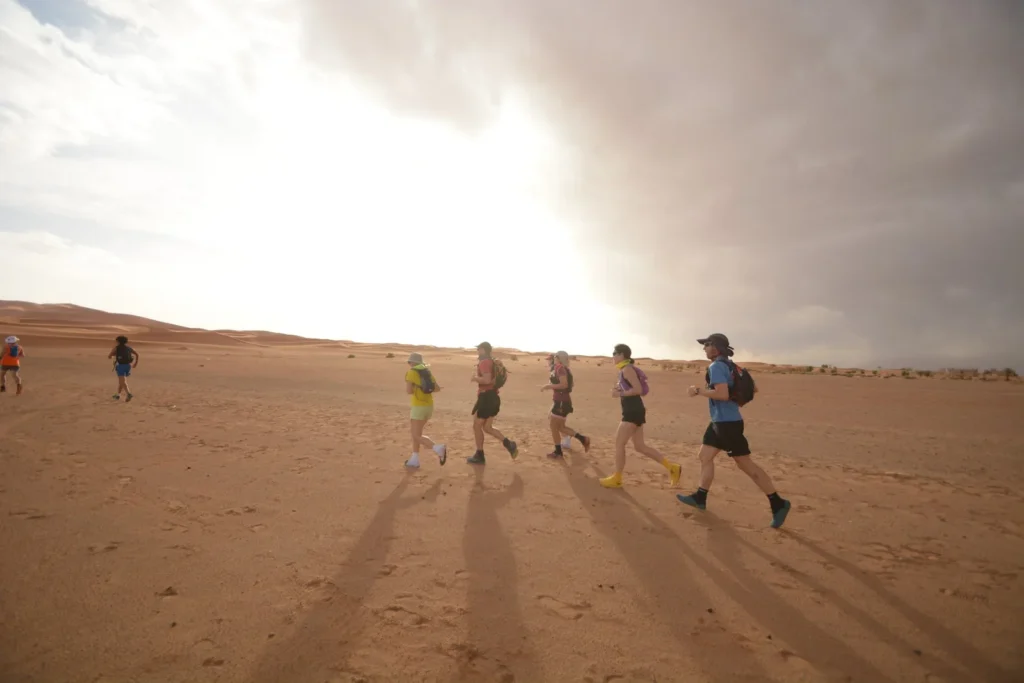
And then there’s Morocco. I remember one adventure waking up at 3 AM in the desert, running behind Abdu for two hours in the sand. The air was cool, the silence immense. We’d stop, and an expert would show us the stars, so many you felt like you could touch every single one. After that run, we’d watch the most beautiful sunrise, the desert waking up in a blaze of color. Those are the moments we create with our small groups. We’re not just running; we’re time traveling, experiencing a way of life that’s centuries removed from our own. We go deep into valleys, far from any tourist bus, finding incredible people who live simply. They speak a language I’ve been trying to learn for years, Berber, and they welcome you like family. It’s about connecting, sharing a meal, a cup of tea. It’s about building friendships that last long after the dust has settled. It’s these kinds of raw, deep experiences that transform you, teaching your body and mind what it truly means to move through varied terrain, to adapt, to push, and ultimately, to **run downhill faster** because you trust the ground beneath you.
Our NomaTrails Approach to Running Downhill Faster
Running downhill isn’t just an excellent way to build strength and endurance; it’s an art form. But to truly become a master of the descent, you need to get off the road and away from the treadmill. This is where a running adventure with NomaTrails comes in, taking you into the mountains where you’ll face steep grades, varying slopes, even snow, mud, and all sorts of terrain. It might seem intimidating at first, but it’s actually incredibly fun when you’re fully immersed! You’ll walk away from these adventures knowing exactly what it’s like to tackle each of these obstacles because, as we always say, there is no better way to learn than by doing.
1. Embrace Diverse Terrain: Let the Trail Teach You
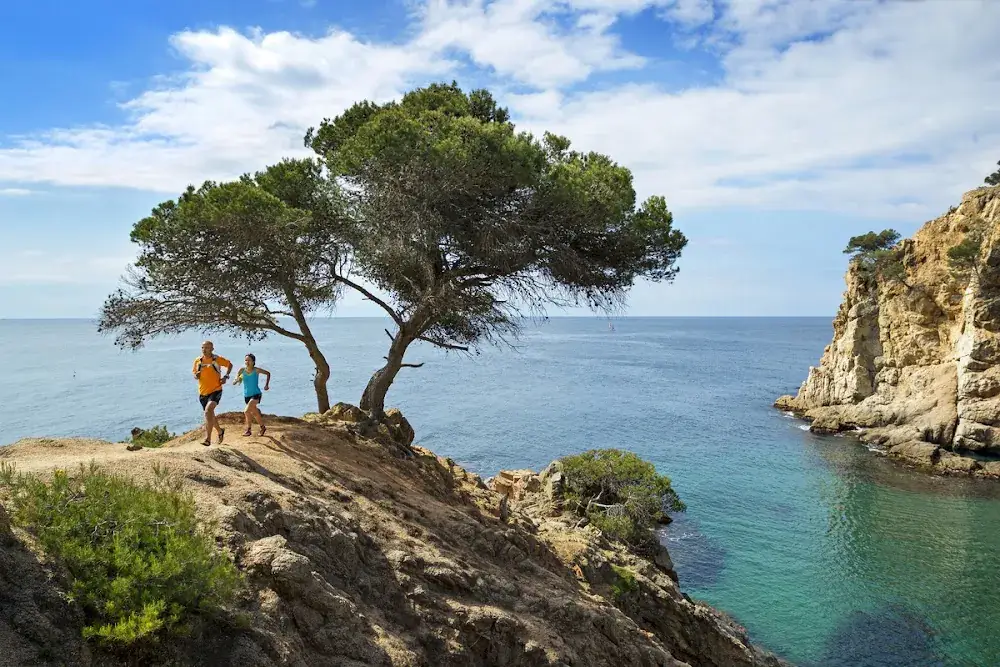
To truly **run downhill faster**, you need to simulate the terrain you’ll encounter on a real mountain adventure. That means getting out there and enjoying challenging hikes or runs on mud, snow, ice, steep grades, ski slopes, roots, switchbacks, and boulder fields. When we’re in places like the Costa Brava, we make sure to hit every kind of surface imaginable. We run everything from coastal paths to inland mountains, through pine forests and along ancient dry stone walls. The more you practice on varied ground, the more your body learns to react. It’s a skill, like any other, and it improves with dedicated practice. Start with a gentle slope and gradually move onto more difficult ground over several weeks as your skill and confidence grows. It’s all about building that deep connection with the land.

Prepare yourself for the demands of running downhill fast by climbing in steep terrain too. The more time you spend ascending, the more accustomed your body will become to breathing hard, carrying extra weight up a hill, and maintaining balance when moving forward in an unstable environment. Challenging terrain is an important element of many of our adventure racing events. It forces your body to adapt, resulting in strength and agility that will prepare you for tougher challenges. It’s all part of the journey. You’ll find beautiful running itineraries, run descriptions, and running videos on our site, showing you just how varied and rewarding these experiences can be.
2. Trust Your Instincts: Turn Off Your Brain (Sometimes)
In running, sometimes the best course is no course at all. Runners who are afraid of injury often over-think their races, slow down, and don’t run hard enough. If you want to **run downhill faster**, you need to pay more attention to your instincts, not your thoughts. Trust your body. Let it flow. This is a core part of the NomaTrails philosophy – to be present, to let the trail guide you, to experience the transformation that happens when you truly let go. I remember a moment in Morocco, running through the Atlas Mountains with Abdu. We were running in the middle of nowhere towards a place I didn’t even know existed. After a while, we found this beautiful valley, a remote oasis miles from any tourist path. We stumbled upon a family, a little girl, maybe 12 years old, working by an irrigation channel in a deep canyon. Her face, it was just beautiful, like fresh cornflakes. She didn’t hesitate. She immediately ran off, gathered some wood, made a fire for us, and offered us tea. We were just strangers, sweaty and dusty from the trail, and they welcomed us into their home. That’s when the magic happens, when you truly let go of your expectations and embrace the unexpected. These are the stories you tell your grandkids, the experiences that change you. That’s the kind of trust you build with the trail when you let your instincts take over.

It’s not simply about ‘disengaging your brain’ entirely, especially for an inexperienced runner. You should build up the skill set of balance, coordination and fast reaction time while also having the core and leg strength to absorb the impact of downhill running. Only when you have these attributes will you gain confidence and be able to relax on descents. But once that foundation is there, learn to let go and trust your feet.
3. Refine Your Form: Lean, Shorten, Relax
Being relaxed allows you to descend more quickly and with less effort. Allow gravity to propel you forward. Avoid jerky movements and aggressive push-offs that waste energy. This is especially important in longer races where efficiency is essential. I’ll often go through a mental checklist from head to toe as I run downhill. Am I hunching my shoulders? Am I tensing my arms and hands? Do my hips feel tense? Do my feet relax or remain flexed after impact? Am I smiling or frowning? We are often unaware of how we tense up on downhills, so becoming more aware of your body’s tendencies will help you relax and truly **run downhill faster**.
The natural instinct when running downhill is to lean backwards and land on your heels. This might feel secure, but it isn’t very efficient and has a braking effect. As you run downhill, try to lean forwards slightly to stay perpendicular to the hill. This will bring your center of gravity forwards, allowing you to land with your weight over your feet. Long strides and landing out in front of your hips also has a braking effect and results in your quadricep muscles absorbing a lot of force, which can quickly lead to fatigue and ‘jelly legs’. A better way is to shorten your stride and land with your foot closer to your hips and with a slightly flexed knee. This fast cadence is particularly important on rough and uneven terrain. Short, fast strides reduce the impact of running downhill and allow you to react quickly.

Let your arms relax from the shoulders, rather than holding them rigidly. If you watch good runners coming downhill you’ll see that their arms ‘windmill’ or flail around like a rag doll. This isn’t them being out of control; they are actually using their arms for balance. It’s a dance with gravity, not a fight.
For more insights, check out our tips on 12 ways to improve your running technique and mastering dorsiflexion.
4. Look Ahead and Gear Up
Just like driving a car or riding a bike, you should learn to read the ground that’s coming up. Try to focus on the floor about two meters ahead of you rather than looking down at your feet. On easier sections, quickly scan the ground farther ahead so that you know what to expect before you arrive. That way, you won’t be tripped by any unexpected obstacles. This foresight allows you to choose the best line, to anticipate, and to flow seamlessly down the trail.

Trainers with a good grip are absolutely essential. Even the best descender would struggle to cope with a steep muddy slope while wearing a pair of road running shoes. There are plenty of models to choose from, with Inov-8, Salomon and Walsh being some of the most popular brands. Good shoes give you the confidence to push your limits, to trust your footing on tricky terrain. It’s about having the right tools for the job, so you can focus on the run, not on slipping. For more recommendations, see these pros’ fave shoes.

5. Build Foundational Strength
Add some strength training into your weekly routine, targeting the lower body. Include exercises such as squats (including single leg), lunges, glute bridges and deadlifts. Drills that focus on developing fast feet and lateral movements are worth regularly including, too. Good descenders rely on a strong core, so work on this. Exercises such as planks, bridges, and lunges will all help; it’s not just about running. Strong muscles support your joints, absorb impact, and give you that explosive power needed to navigate technical descents. This foundational work allows you to **run downhill faster** with greater control and less risk of injury.

Don’t get us wrong, there’s a lot of benefit from hill repeat training and few feelings are sweeter than overtaking runners on a grindingly steep ascent. But running downhill is not simply a time to recover – there are seconds to be gained if you can learn the skills and confidence to go full pelt, too. The key to improvement is practice; you didn’t learn to ride a bike in one go and likewise it takes time to develop the various skills to improve your downhill running. Try to incorporate downhill training into your regular runs. This video shows how you might practise running down a short, steep hill:
So, work on your technique and you never know, it might be you flying down past others as they tentatively make their way downhill. These adventures, these moments of deep connection with the trail and the people, they change you. They build memories and stories you’ll tell your grandkids. Be careful, though. You’ll go back home changed. If you think that’s a good idea, running point to point, discovering a new place every day, exploring, then you’re one of us. You’re welcome to come.