
If you are new to the running trails world, don’t let the idea of **trail running for marathon training** scare you. It’s a game-changer, I promise. For us at NomaTrails, running isn’t just about hitting a certain pace or logging miles. It’s about moving through a place, connecting with the land, and letting the journey change you. When we run, we’re not just training our legs; we’re training our souls. And that, my friend, is exactly what makes it such a good way to get ready for a marathon, or anything else life throws at you. We don’t just pick any place to run; we go where we have a deep relationship, where we can say, “This is my grandma’s village,” or “This is the school my kids went to.” Otherwise, it just wouldn’t feel real.
Benefits of Trail Running for Marathon Training
True, trail running might very well help you improve your road running. It’s not just theory; we see it happen with our runners all the time. I’ve watched people come to us feeling stuck, and leave transformed. Here’s why:
Muscles that are not used for running on the road are strengthened. When we were planning our Sicily running adventures, Pasquale, our guide, talked about how we’d start at the sea and push through the rural countryside, climbing into the mountains. We’d traverse valleys, not just go straight up peaks. He described how we’d pass through mountain villages, then cross the upper part of the island, descending towards the sea again, maybe sleeping in a place like Isnello, where you can practically see the ocean from your window. That kind of varied terrain – the constant small adjustments, the ups and downs, the uneven ground – it hits muscles you didn’t even know you had. It builds a kind of robust, adaptable strength you just don’t get on asphalt. Your body learns to move in a much more complete way.
It reduces the likelihood of overuse injuries while allowing you to record more training miles. Think about it: every step on a trail is a little different. A rock here, a root there, soft earth, hard-packed dirt. Your body is constantly adapting, making tiny, unconscious adjustments. This natural variability means less repetitive stress than pounding the same pavement mile after mile. We’ve seen runners come to us with persistent road injuries, and after a few days on the trails, they feel a difference. It’s like their body remembers how to move naturally again, finding a more fluid and less impactful rhythm. This kind of movement helps build resilient joints and connective tissues, crucial for long-distance training.
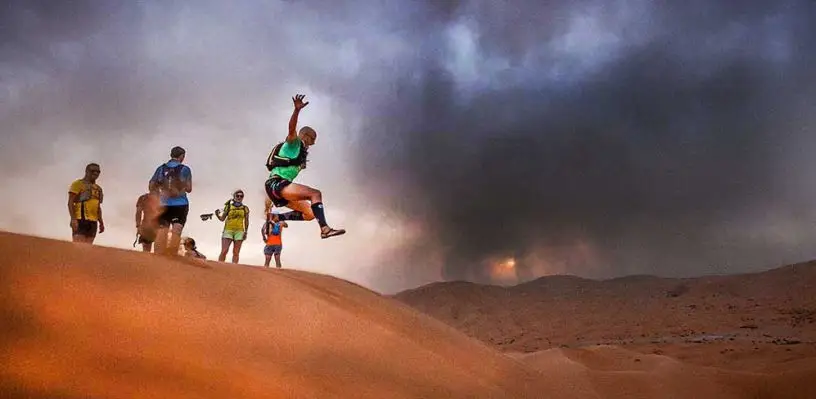
Running outside relieves stress. A less stressed-out body and mind can concentrate on working out harder. I remember one morning in Morocco, waking up at 3 AM. We ran for two hours in the desert sand, just Abdu and me, under a sky so full of stars you felt like you could touch every single one. There was no light pollution, just the vast, silent desert and the Milky Way stretching overhead. We stopped, completely alone, and watched the most incredible sunrise paint the dunes in oranges, pinks, and purples. That’s not just a run; it’s a reset for your entire being. It clears your head in a way no track session ever could, leaving you feeling calm, focused, and ready for whatever challenge comes next, whether it’s another 15 miles or a marathon finish line. It’s a profound way to connect with yourself and the world.
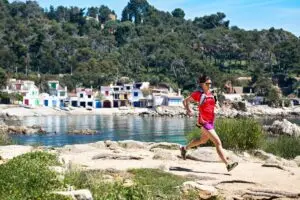
It promotes overall equilibrium. You’re constantly scanning the ground, shifting your weight, balancing. It’s a full-body workout for your proprioception – your body’s awareness of its position and movement. On our Costa Brava trails, where the path can change from smooth dirt to rocky coastline in a heartbeat, you learn to trust your feet and your body in a whole new way. You’re not just running; you’re dancing with the terrain.
Not only that, but it helps to strengthen your core, which is necessary for proper running posture. We’ll get into this more, but imagine needing to balance on a narrow path with a drop-off, or scrambling over rocks. Your core is working overtime, stabilizing you with every step, preventing falls, and making your movement more efficient. It’s a foundational strength that translates directly to better, injury-free running on any surface.
“Sometimes I’ve been wrong on the way, but I’ve learned that it’s no use complaining: I’ll have to accept the mistake and make up for that lost time in the race.” Kilian Jornet in The Pyrenees
Trail Running for Marathon Training: Our Approach
For us, **trail running for marathon training** isn’t just about following a plan; it’s about an experience. We use running as a way to explore, like our ancestors did. It’s not about being slim or fast; it’s about traversing territory, seeing places only runners can see. Our NomaTrails adventures are built on this philosophy, whether we’re in Costa Rica, Sicily, or the Atlas Mountains of Morocco. We don’t just run *in* a place; we run *with* it, getting to know the people who live there, sharing meals and stories. These are the kinds of memories you can tell your grandkids, stories that truly change you.
Trail marathon training plans are similar to road marathon training plans in that you should perform long runs on trails. However, those long runs will substitute for the long runs on roads that you would typically do for a road marathon. You should try and hit the trails as much as you can, but at least once a week.
To simulate the course that you’re going to race on, you should run a challenging workout plan with plenty of time in between workouts. This way your body has time to adapt and can perform the running skills necessary for a trail marathon.
Trail Running for Marathon Training: It’s Not Just About Pace
Don’t get hung up on your pace. Every mile that you run is created differently due to terrain, elevation profile, and even weather conditions. Pace is not as important as the overall effort that you put in. When we’re out there, especially in places like Morocco, we’re not looking at our watches every five seconds. We’re looking at the path ahead, the view, the people we meet. It’s about being present, about the journey itself. I remember one day in Morocco, running towards a place I didn’t even know existed. We were in the middle of nowhere, five and a half hours in the opposite direction from where any tourist bus would go. We ran for hours, and then, suddenly, this Berber family appeared in a beautiful, remote valley. That kind of experience, that unexpected connection, that’s what stays with you, not your average pace for the day. We were just traversing the territory, letting our legs carry us to something truly special.
How long is a mile in a trail run?
To get a sense of how long one mile might take you, it’s important to consider what’s happening on the trail. To do that, take your top pace and subtract from it whatever you think is a realistic uphill grade. For example, if what you usually run with ease is 6:20/mile, but when you train on an incline trail 9:30/mile seems like an option (this makes the total elevation gain 1,200 feet), then subtract 1:50 from 6:20. This gives 7:40 per mile in the trail run — still above your usual threshold, but acceptably gradual. But honestly, sometimes, especially on our Sicily running adventures, you just have to throw the watch out the window and run by feel. The views, the smells, the unexpected turns – that’s the real measurement of a mile, the richness of the experience, not just the numbers on your wrist. For a deeper dive into adjusting your expectations, you might find articles on iRunFar helpful.
Running in Trails for Marathon Training: It’s All About Your Core
Cross-training is an awesome way to stay healthy and fit—and it’s essential for any trail runner. By incorporating activities like swimming, biking, hiking, skiing and paddleboarding into your routine, you can burn calories quickly and strengthen important muscles that support your running gait.
Strides are fast, with lots of knee and ankle changes. They also require you to stabilize your body and get it ready for quick changes in direction.
Trail running calls for shorter, choppier steps that keep you light on your feet. Work on your foot and ankle strength and work on your lateral stabilizing muscles to become more in tune with the trail.
Working on these small stabilizing muscles helps to prevent injury, especially if you happen to be one of the minority of runners who run poorly downhill and downhill sprints.
You heard it here first: A strong core is going to help keep you upright when you hit bumps on the trail. Your body takes a different kind of impact on a trail than on a flat road, because you’re working so many more muscles that connect at different points of your body. And what better way to strengthen them than with a trail run? I remember one of the most extraordinary days of my life in Morocco. We were running, backpacking, deep in this remote canyon, far from anywhere, truly in the middle of nowhere. We didn’t know what was around the next bend. Suddenly, we came across a Berber family working by an irrigation channel in this very deep canyon. This little 12-year-old girl, with such a beautiful, striking face, immediately ran off to gather wood, made a fire for us, and offered us tea. We were just passing through, dusty and tired, and they welcomed us into their home. That kind of terrain, that kind of unexpected interaction in a place that felt centuries away from our own, it demands a strong, adaptable body and a ready spirit. Your core, your balance, your ability to react to the ground – that’s what keeps you moving, keeps you safe, and opens you up to those truly special moments. It’s not just about getting fit for a marathon; it’s about being ready for life, for the adventure around every corner, and for connecting with people in the most authentic ways. For more on the physiological benefits, check out resources like Runner’s World on Trail Running.