
Trail Running in Iceland: A Runner’s Guide
Honest note before you read on: we don’t currently run Iceland trips. This guide covers what to look for in an Iceland trail operator. If what draws you is high-mountain scenery, glacial rivers and a crossing that ends at the sea, our Pyrenees to the Med holiday is the closest thing we make — compare below.
| Iceland | Pyrenees (ours) | |
| Terrain | Volcanic, exposed, weather-ruled | High ridgelines, forests, villages |
| Season | Jun–Aug only | Jun–Sep |
| Typical cost | €€€€ (logistics-heavy) | €€ — guesthouses & refuges |
| Finish | Varies | A swim in the Mediterranean |
In short: Iceland offers some of the world’s most dramatic trail running from June to September – from the 55 km Laugavegur trail to the 22-waterfall Fimmvörðuháls route – with 20+ hours of summer daylight and no dangerous wildlife on the trails.
Our running adventure guides and founders
Cristina and I, Pablo, share our passion for these trail running adventures. We’re always here to help.
Please contact us if you have any question.
Running Adventures, Running Vacations
When we talk about places that truly get under your skin, that change you, Iceland always comes up. For us at NomaTrails, Iceland trail running isn’t just about logging miles; it’s about connecting with a raw, untamed land. In fact, we’ve brought runners from all corners of the globe here, and every single time, they leave changed. This place has endless trails and dramatic scenery. And it isn’t just ideal for running—it’s a world-class theater for endurance sports, shaped by fire and ice.
Our incredible local guide, Inga Fanney Sigurðardóttir, a true force of nature herself, often tells us how she found the magic of trail running here. After starting a family, with less time for long hikes in her northern Icelandic home mountains, running became her way to intimately experience the land—feeling every rock, smelling the unique flora, absorbing that raw, powerful nature. Inga, whose story is even captured in a film about her adventures (check out her movie on IMDb), has been our partner in crafting unforgettable Iceland trail running experiences. She knows these trails like the back of her hand, and these are her top eight reasons why Iceland is an absolutely amazing spot for us runners:
8 Reasons Iceland is the Ultimate Trail Running Destination
1. Temperatures are ideal for running.
For Iceland trail running, the temperatures are just perfect. I remember one summer run, pushing hard up a climb, feeling the cool air on my face. It’s rarely too warm, always refreshing. During our prime running season, from roughly May to September, you’re looking at averages between 5–12°C (41–54°F). It’s that sweet spot, a five-month window where you can really push your limits without feeling like you’re melting. The country sits near the Arctic Circle, so you get this dynamic mix of warm Gulf Stream air meeting cold Arctic currents. It keeps things crisp, keeps you moving.
2. Our water is uncontaminated and safe to drink anywhere.
This is a big one for us at NomaTrails. Imagine running for miles, feeling the burn, and then just bending down to cup your hands and drink directly from a stream. No filter, no worries. Our water is pristine, untainted, straight from the mountain sources. It’s not treated with anything. Out in the backcountry, it’s perfectly safe to drink straight from the streams and glacial rivers that crisscross your path. It tastes incredible, so clean and vital. This means we can run lighter, carrying just a small flask, refilling it whenever we pass a bubbling stream. It’s pure freedom, knowing your hydration is literally flowing right beside you.
3. The environment is incredibly clean.
The air here, the ground under your feet—it’s incredibly clean. Protecting this nature isn’t just a priority; it’s a fierce commitment for Icelanders. We see it in how they live, how they respect the land. The ecosystem is fragile, especially the slow-growing moss that carpets so much of the terrain. When we’re on our Iceland trail running trips, we always emphasize sticking to the marked paths, moving lightly, leaving no trace. Much of this country is protected wilderness, including the massive Vatnajökull National Park, home to Europe’s largest glacier, covering a huge chunk of the island. And it’s not just the trails. Even their homes, swimming pools and greenhouses are sustainably heated with geothermal water, pumped right from underground. In short, it’s a powerful example of living in harmony with the earth.
4. Rejuvenating natural hot springs are abundant.
After a long day of Iceland trail running, there’s nothing quite like sinking into a natural hot spring. Iceland sits right on one of the planet’s biggest geothermal hot spots, meaning underground water is constantly being heated, creating these incredible, mineral-rich pools all over the country. I remember one evening at Landmannalaugar, after a challenging run through those colorful mountains, we soaked in the “People’s Pools.” The water was this perfect 36-40°C (97-104°F), year-round. Every muscle just unwound. In places like the Westfjords, you see locals building these simple bathing pools with rocks and moss, just harnessing what nature provides. It’s pure therapy for the body and soul.
5. Explore truly untamed wilderness.
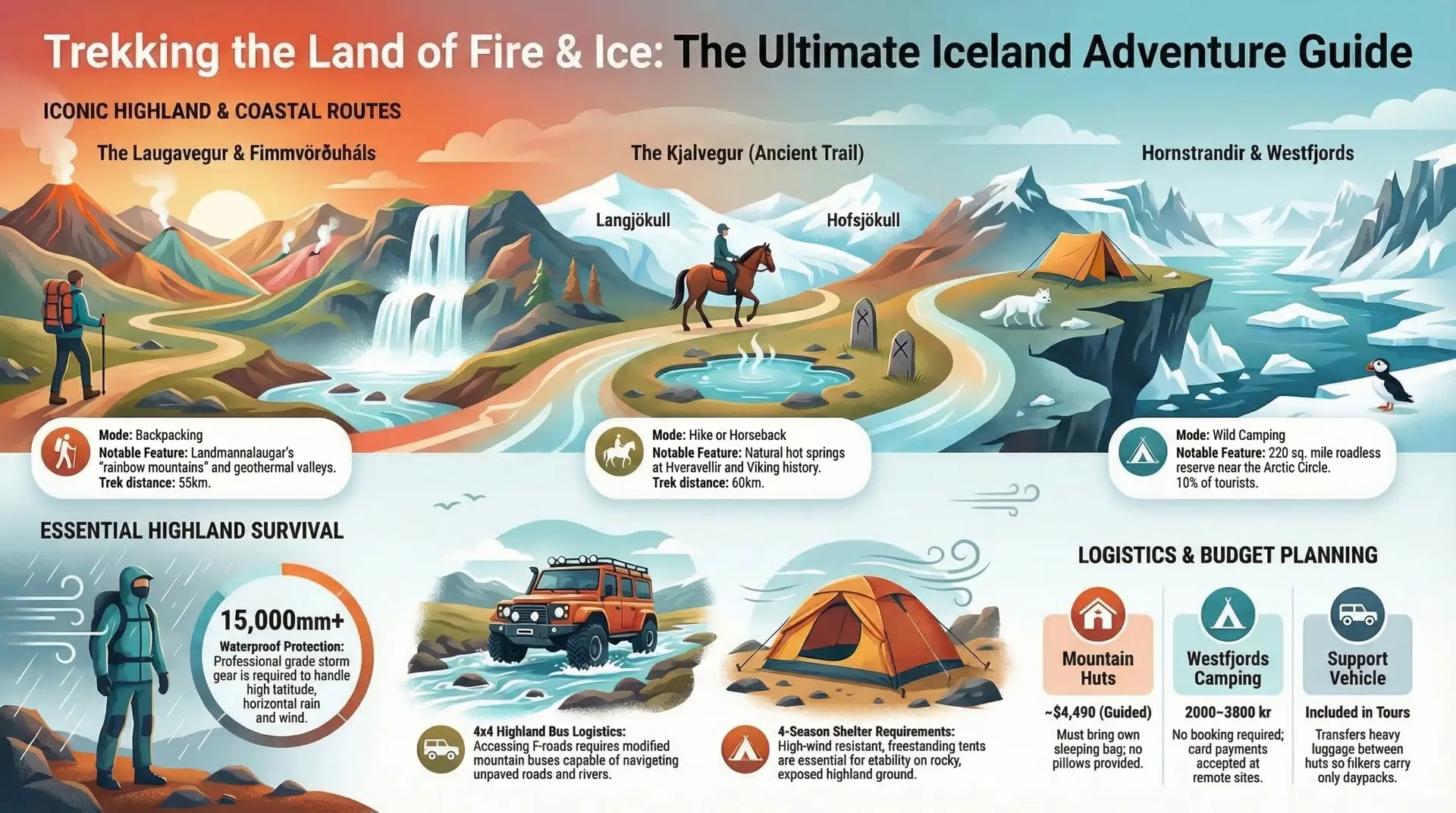
If you’re looking to truly disconnect, to run where human impact is almost non-existent, Iceland is your place. Indeed, so much of it is uninhabited. We’ve traversed routes like the legendary 55 km Laugavegur Trail, where you feel miles away from anything, just you and the vastness. For the ultimate isolation, we’ve even taken boats to the Hornstrandir Nature Reserve in the Westfjords—they call it “Europe’s last wilderness.” No roads, no permanent residents. It’s an unparalleled off-the-grid running experience, a chance to really feel small and connected to something ancient. It’s why we come here for Iceland trail running; to find that raw, untamed heart of the world.
6. Iceland has no pests or predators.
This might sound too good to be true for many runners, especially those of us who’ve battled swarms of mosquitoes or kept an eye out for larger wildlife on trails elsewhere. But in Iceland, it’s a reality: no pests, no predators. You can run deep into the wild with total peace of mind. No mosquitoes, no snakes, no large carnivores. Our only native land mammal is the Arctic Fox. They are beautiful, shy, completely harmless to humans, and heavily protected. As a result, you can truly lose yourself in the remote regions. You focus solely on your stride, the scenery, and the feeling of the trail beneath your feet. It’s a freedom that changes how you approach Iceland trail running completely.
7. No two running trails are alike.
No two trails are alike here; it’s like the earth itself is constantly reinventing itself. Because of its volcanic genesis, the terrain shifts drastically, sometimes within a single mile. I remember one run on the Fimmvörðuháls trail—it was mind-blowing. We passed 22 different waterfalls, one after another, each more spectacular than the last. We ran between two colossal glaciers, Eyjafjallajökull and Mýrdalsjökull, feeling the ancient ice on either side. Then, suddenly, we were crossing fields of fresh lava and ash from the 2010 eruptions, the ground crunching underfoot, still raw. Up in the highlands, you transition from mountains striped with vibrant, silica-rich rhyolite to sharp, glass-like obsidian fields. You sprint across vast black volcanic ash deserts, then descend into lush arctic birch forests, the air suddenly soft and green. It’s a sensory overload, a constant surprise, and it makes every Iceland trail running step an adventure.
8. 24 hours of daylight.
This is truly a phenomenon you have to experience to believe. Around the summer solstice, and for much of June and July, Iceland experiences nearly continuous daylight. No real night. Imagine starting a run at 8 PM, and it feels like midday. It completely changes your perception of time and distance. We’ve done runs that stretched for hours, exploring off-trail and letting curiosity be our guide. Best of all, we never felt rushed by a fading sun. That endless daylight fuels the most adventurous runs across this incredible land. They even celebrate it with events like the annual Suzuki Midnight Sun Run in Reykjavík, where people race through valleys under a glowing, sunlit “night” sky. It’s an unforgettable feeling for any Iceland trail running enthusiast.
Best Season for Trail Running in Iceland
The best season for trail running in Iceland is mid-June to mid-September, when the highland trails are largely snow-free, mountain huts are open, and daylight stretches past 20 hours around the summer solstice. July and August are the most reliable months underfoot; the shoulder weeks in June and September are quieter but carry a higher chance of snow, swollen river crossings and fast-changing weather. Outside summer, most highland routes are snow-covered and many mountain roads are closed.
Iceland Trail Races
If you would rather pin on a number, Iceland has a small but spectacular racing scene, concentrated in the summer:
- Laugavegur Ultra Marathon – the country’s flagship trail ultra, roughly 55 km along the famous Laugavegur trail from Landmannalaugar to Þórsmörk, run in July.
- Fimmvörðuháls race – crosses the dramatic pass between the Mýrdalsjökull and Eyjafjallajökull glaciers.
- Súlur Vertical – a mountain-running weekend in the hills above Akureyri, in the north.
- Reykjavík and Mývatn marathons – road-leaning summer races for runners who want an Icelandic backdrop.
Exact dates shift year to year, so check each organiser’s current calendar before you book flights.
Our NomaTrails Iceland Trail Running Adventures
For years, NomaTrails brought runners to Iceland, collaborating with local experts like Inga Fanney and her team at Arctic Running to create authentic, deeply immersive journeys. We no longer run Iceland trips — but those years shaped who we are, and everything in the guide above comes from running that ground ourselves. Here’s what those journeys looked like.
A Glimpse into Our Iceland Trail Running Journeys
A typical Iceland adventure spanned 7-8 days, taking runners deep into the heart of this land of fire and ice. We kept our groups small for a personal, connected experience. Days ran 6 to 16 miles; an intermediate running ability was recommended, but it was always about the journey, not just the speed.
Imagine arriving in Reykjavík, then heading straight into the highlands. Our first run might take us through Þingvellir National Park, a place steeped in history and geology, or around the base of the mysterious Mt. Hekla, an active volcano. We’ll run across green and black mountains, towards the colorful rhyolite landscapes of Landmannalaugar. Here, you’ll encounter hot springs and mud pools, and after the run, we highly recommend a bath in the natural hot pools. It’s pure bliss for tired legs. Finally, we might drive further into the western part of Vatnajökull National Park. There, we run through black-sand deserts where the only company for miles are beautifully shaped hills of volcanic ash.
Another highlight is running close to the mighty Vatnajökull glacier, exploring glacial lagoons like Fjallsárlón and Jökulsárlón, where icebergs break off and drift into the Atlantic. We also tackle the legendary Fimmvörðuháls pass—a 15-mile singletrack with 1000m of elevation. It takes you past countless waterfalls, between the Mýrdalsjökull and Eyjafjallajökull glaciers, and across fresh lava fields from the 2010 eruption. This incredible route often ends in the green oasis of Þórsmörk, the Valley of Thor, where a hot pool and sauna await.
What Our Iceland Trips Were Like
We believe running is a means of transportation, a way to truly see a place. A NomaTrails Iceland trail running trip included expert local guides who knew every twist and turn, comfortable vehicle transportation between running points, and most meals—often prepared together, creating a beautiful shared experience. We stayed in cozy mountain huts or welcoming guesthouses. Runners carried only water and snacks for the day’s run; main luggage was transported for them. Every day was a new discovery, with stops to explore culture, history, and geology along the way.
Why Runners Chose Our Iceland Trips
We were never just about the miles; we were about the memories, the stories you’d tell your grandkids. Our philosophy, as my friend Pablo says, is about deep connections—to the place, to the people, to yourselves. When you ran with us in Iceland, you weren’t just a tourist; you were part of our nomadic family. Those trips were designed to change you, giving perspectives you won’t find anywhere else.
“Both of my guides were very knowledgeable about the geography, history and culture of the region, and both excellent, strong runners,” shared Bryn D. from Australia. “Amenities on the overnight trips were excellent, with carefully chosen campsites, great food and roomy tents. The addition of a driver to haul gear on the longer trip also freed our minds to concentrate on the travelling. Would recommend without hesitation.” That’s the kind of feedback we live for.
Maria M. from New York added, “They were so friendly, knowledgeable, and down to earth. Not only did they fill us in on historical information but they also had great recommendations for places to go in town and ultra runs to do in Iceland.”
And Sasha from North Vancouver perfectly captured the spirit: “My husband and I had tossed around the idea of running on our own, without a guide, but we are so incredibly glad we opted for a guided trip with Arctic Running instead. The guides took us to remote places we never would have seen otherwise, and taught us about the distinct geography and local legends. The food was phenomenal and plentiful. I’m sure we gained weight despite the 100 kms of running! I underestimated how much I would appreciate this luxury. I’m used to eating energy bars and trail mix… Ending the run with a bowl of soup (it was chilly), followed by a huge dinner of fresh local seafood, or BBQ’d lamb was amazing (though they can cater to vegetarians as well).”
Our Iceland Partner: Arctic Running
We were proud to partner with local experts like Inga Fanney, founder and CEO of Arctic Running. Inga is a runner, a teacher, a guide, and a true enthusiast of Iceland’s wild places. She and her team have designed tours that not only challenge you on the trails but also give you time to truly appreciate the spectacular natural surroundings. With NomaTrails and Arctic Running, you got the best of both worlds: our philosophy of deep, human-centered adventure, combined with unparalleled local knowledge.
Drawn to this kind of running? Iceland isn’t on our current calendar, but the same spirit — high mountains, wild terrain, small groups — runs through every trip we guide today.
And every single journey with us exemplifies the spirit of our unforgettable trail running vacations.
We’ve brought runners from all corners of the globe here, and every single one has experienced the profound transformation that comes from immersing oneself in nature, a feeling we also cultivate during our running retreats.
Iceland Trail Running: FAQ
When is the best time for trail running in Iceland?
Mid-June to mid-September, with July and August the most reliable. That is when highland trails are snow-free, huts are open, and daylight runs past 20 hours.
Do you need a guide to trail run in Iceland?
Not for marked, popular routes like sections of the Laugavegur trail, but a guide or a well-prepared plan helps on remote highland routes where weather, river crossings and navigation get serious. Always carry offline maps and tell someone your route.
Is it safe to trail run alone in Iceland?
Iceland has no dangerous wildlife, so the terrain and weather are the real hazards. Check the forecast, start conservatively, carry a layer and water, and download offline maps before you lose signal.
How hard is the Laugavegur trail to run?
The full Laugavegur is about 55 km with significant climbing, river crossings and exposed highland sections – a serious outing best suited to experienced trail runners, though strong hikers cover it in stages.
Does NomaTrails run guided trips in Iceland?
Not any more. We used to, and this guide comes from those years – but our current guided trail running holidays are in Morocco, Costa Rica, Sicily, the Pyrenees and the Costa Brava. See where we run now.